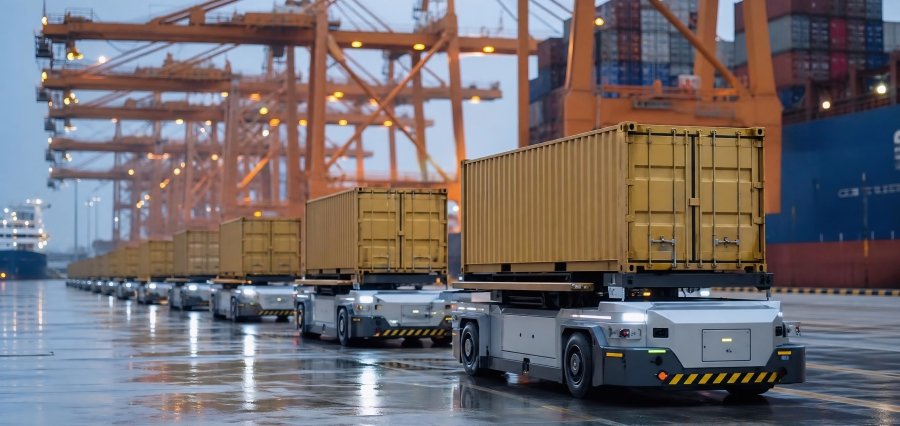
Every supply chain manager knows the drill, orders piling up, not enough people to handle them, and customers wanting their stuff yesterday. Labor shortages, climbing fuel prices, and demand that swings without warning have been wearing down traditional logistics operations for years. Peak season hits and warehouses just can’t staff up fast enough.
Driver shortages aren’t getting better either, and customers still expect the same fast, perfect delivery regardless. Margins keep getting squeezed. At some point, hiring more people and hoping for the best stops working, and overtime just burns money without solving the actual problem. What companies need is simple, move goods faster, cut down on mistakes, and quit scrambling every time something breaks down. Autonomous Logistics fills that gap, keeping things running even when staff and resources are stretched thin.
What Is Autonomous Logistics?
Autonomous Logistics boils down to self-operating systems, autonomous vehicles, robots, smart software, that handle moving, storing, and delivering goods without needing someone at the controls the whole time. Older logistics setups depend on manual labor and rigid schedules, but this approach does not work that way. It runs on sensors, learning algorithms, and connected networks to make calls in real time, so warehouses, distribution hubs, and transport fleets end up moving faster and slipping up less.
None of this happened by accident. Fuel costs keep climbing, drivers are harder to find, and demand swings up and down without much warning. Companies had to find something more dependable, and that is exactly what pushed adoption forward across warehousing, freight, and last mile delivery.
Why Autonomous Logistics Matters for Supply Chain Performance
Most people judge supply chain performance on four things, speed, accuracy, cost, and how happy the customer ends up being. Autonomous Logistics moves the needle on all four. Machines do not get tired or distracted. Processing orders, sorting inventory, and routing shipments happen nonstop, which shaves a good chunk off processing time. That shows up as shorter lead times and quicker turnaround, both for the business and the person waiting on their package. Labor is also one of the heaviest costs any supply chain carries, and automation chips away at that by taking over repetitive jobs like sorting, loading, and moving goods from point to point. Over months and years, that adds up to real savings and better margins.
Mistakes are another constant headache in logistics, wrong shipments, misplaced stock, dispatches that go out late. Precise tracking and automated decisions mean a lot of these errors simply stop happening. There is also the scaling problem. Growing a workforce fast is slow and expensive, but automated systems can flex up or down with demand almost immediately, with none of the delay that comes from hiring and training new people.
Last Mile Automation Is a Critical Piece of the Puzzle
This kind of automation touches the whole supply chain, but its most visible impact shows up right at the end, the final delivery. Last Mile Automation is the automated handling of that last stretch, from a distribution hub straight to someone’s front door. This last leg happens to be the most expensive and slowest part of the whole chain, eating up a huge share of total delivery costs. Last Mile Automation chips away at that problem using delivery robots, drones, and autonomous vehicles built to move through city and suburban streets on their own.
Companies putting money behind this kind of delivery automation are already seeing it pay off in faster deliveries and happier customers. Instead of leaning entirely on human drivers stuck in traffic or hunting for parking, automated systems adjust routes on the fly, which cuts down on delays and missed windows. There is an environmental angle too, since these systems tend to run on electric vehicles and drones that use far less energy than a standard delivery truck, which helps sustainability goals while also boosting efficiency. As cities keep growing and delivery demand climbs with them, this is looking less like an experiment and more like the standard way of doing business.
Real World Applications of Autonomous Logistics
A handful of industries are already putting these systems to work in ways you can actually measure. Warehouses use automated guided vehicles and robotic arms for picking, packing, and sorting, and they do it fast and with very few errors. Freight companies are testing and rolling out self-driving trucks on long haul routes, cutting down on the fatigue-related risks that come with long stretches behind the wheel.
Retailers lean on this kind of automation to keep shelves stocked and dodge the kind of stockouts that send customers elsewhere. And in e-commerce, automated delivery through robots and drones is what actually makes same day shipping promises possible for online sellers. Put together, these examples make it clear that this is not some distant idea, it is already part of daily operations for a lot of businesses.
Challenges to Consider
None of this comes free or easy. Setting up the infrastructure can cost a lot upfront, and folding these systems into whatever supply chain software a company already runs takes real planning. Rules around autonomous vehicles and drones also vary a lot from one region to the next, which can hold back how quickly this kind of delivery automation spreads in certain markets.
There is a people side to this too. Automation cuts down on the need for manual labor in some spots, but it opens up new kinds of work, things like monitoring systems, handling maintenance, and making sense of the data these systems generate.
What Comes Next for Supply Chains
Down the road, this technology is likely to lean more on predictive analytics and connected devices. That shift should let supply chains catch problems early instead of scrambling to fix them after the fact.
Delivery automation especially still has plenty of room to grow, particularly as cities keep expanding and people expect their deliveries to show up fast and on time, no excuses. Businesses that invest early in these systems are likely to end up with an edge, both on cost and on how customers feel about the experience.
Conclusion
The impact of Autonomous Logistics on supply chain performance is real and still growing. It is cutting costs, tightening up accuracy, and reshaping how goods actually move through global supply chains. Last Mile Automation, as one of its most important pieces, is helping solve one of the toughest parts of delivery, that last stretch to someone’s door.
As the technology keeps maturing, the companies that get ahead of the curve now will be the ones best set up to handle rising customer expectations, keep costs in check, and build supply chains that can take a hit and keep running.