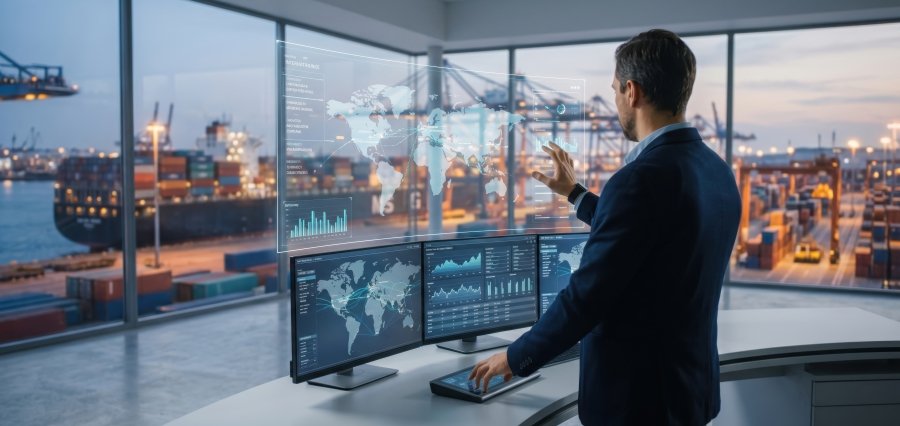
Think about what it takes to move a single shipping container from a vessel to its destination. A crane operator lifts it from the ship. A truck driver moves it across the yard. A customs official checks the paperwork. The logistics coordinator enters data into the system. Every process requires human labor, machines, paperwork, and time. Multiply this by thousands of containers every day, all hours of the day, along some of the busiest trade routes in the world.
Port authorities have been handling this for years using human labor and physical structures alone. It worked, but it was slow, expensive, and prone to error. The world moved on. Trade volumes grew. Ships got bigger. Supply chains got tighter. The old model began to show its limits. What replaced it, and what is now reshaping global trade from the Gulf outward, is the smart port.
This blog discusses what smart ports are, how port digitalization is driving their development across the Gulf region, and why this transformation matters for trade, business, and the broader economy.
What Makes a Port Smart
A smart port is not simply a port with newer equipment. It is the place where technology, information, and automation combine their efforts to speed up and enhance each of the processes.
A smart port utilises AI technologies for the prediction of vessel arrivals and berthing scheduling. IoT sensors are used in cranes, trucks, and even containers for the tracking of cargo movements in real time. Automated guided vehicles are applied for the transportation of containers through the yard without human operators. Blockchain and digital solutions are used for the processing of customs documents and other trading papers in minutes instead of days.
The result is a port that operates with significantly less friction. Vessels wait less. Cargo moves faster. Errors drop. Costs fall. Additionally, all of the data generated by each process serves as feedback for the system, gradually enhancing its performance.
Why the Gulf Is Leading This Shift
Gulf is situated at the junction of international business flows. Sea routes linking Asia, Europe, Africa, and America run via this region, and ports here are among the most strategic points on earth from this point of view. In 2024, ten GCC ports were among the leading 70 ports around the world, which is indicative of the efforts devoted to the improvement of maritime infrastructure in this region.
National visions of different countries of the Gulf Region make logistics and trade improvement crucial points on their agenda. Thus, for example, Saudi Arabia’s Vision 2030 sets the goal to transform the country into a global logistics center. Smart ports are central to that ambition.
This program is complemented by similar initiatives in other Gulf countries like the United Arab Emirates.
The program of Smart Ports was launched by Saudi Arabia in association with Logisti 2, which also involved the use of IoT, AI, and blockchain for the management of ports. One of the most technologically advanced examples of port digitalization in the Gulf Region was the Jeddah AI smart port that applied machine learning and analytics in place of
In the UAE, Jebel Ali Port, managed by DP World, has gone beyond piloting and started automation and green modernization of its port facilities, upgrading its equipment and implementing various automated systems.
The Hamad Port of Qatar has been pretty active in digitalizing and automating its port services to achieve greater efficiency and precision. This port uses container handling systems, intelligent cargo movement systems, and technology-based decision-making techniques.
The Port of Fujairah in the UAE signed a major strategic agreement to build a unified digital architecture across its operations, with a new Port Community System designed to integrate vessel calls, gate security, and bulk handling with real-time analytics.
The Technologies Driving Smart Ports
Several technologies sit at the core of smart port development and are worth understanding clearly.
Automated cranes and vehicles remove the variability and fatigue that come with human operation. They load and unload cargo using software that helps them to do it more efficiently and 24/7.
AI-based berth scheduling uses data from vessel arrivals, cargo volumes, and yard capacity to schedule berths and use resources effectively even before the ships come to ports. This way, it minimises idle times and makes it possible to serve many vessels without additional infrastructure.
All the equipment and all containers are connected to the IoT network and, therefore, to the centralised data system that allows tracking the location of each piece of equipment and cargo and reacting to problems instantly.
Port Community Systems create a common online platform for interaction between all the stakeholders, including shipping lines, customs, freight forwarders, terminal operators and others, making paperwork faster and safer than ever.
What Port Digitalization Means for Business
Port digitalization is not just an infrastructure story. It is a business story.
Efficient ports allow exporters and importers faster clearance, more predictable operations, and reduced logistics costs. Supply chain efficiency and capital liquidity are increased when customs procedures are completed digitally in a matter of hours as opposed to days.
Efficient smart ports for shipping lines translate into short turnaround times and influence shipping economics as vessels spend less time at berth, hence completing more trips throughout the year.
Smart ports that work efficiently and in line with global standards will attract more trade, investments, and activities to the countries hosting such ports.
The freight and logistics sector in Saudi Arabia had a market valuation of over USD 24 billion in recent times, and smart port technology plays a vital role in its growth.
Challenges Worth Acknowledging
The evolution into smart ports does have its own share of complications. Cybersecurity is a real worry. With increasing connectivity of smart ports, the cyber attack surface becomes wider. Ports that digitise operations create new vulnerabilities that require serious protection. A port’s data systems are as critical as its physical infrastructure.
Workforce transition is another consideration. Automation changes the nature of work at ports rather than eliminating it, but it does require retraining and reskilling at scale. The management of that transition is just as crucial as the technology itself.
Integration of existing systems and the new technologies is not only technologically complex but expensive. Ports that move carefully and strategically tend to achieve better outcomes than those that rush deployment without the right foundations in place.
Conclusion: The Gulf Is Building the Ports the World’s Trade Needs
Smart ports are not a future aspiration for the Gulf region. They are an active reality, already reshaping how cargo moves, how trade flows, and how the region competes in global logistics. Port digitalization is the engine of that transformation, linking people, machines and data in ways that make every operation faster and more reliable. For a region that sits at the centre of global trade routes and is investing seriously in its logistics future, the smart port is not just infrastructure. It is strategy.